First, figure out what kind of silence it is
Before you write anything, check which of these you're dealing with:SituationWhat they probably need
Proposal or quote sent, no replyTime, or a reason to decide
You asked a question, no answerA shorter, easier question
You're waiting on files, approval or accessA reminder with a clear deadline
Active client, conversation just stoppedA check-in that isn't about selling
When to follow up
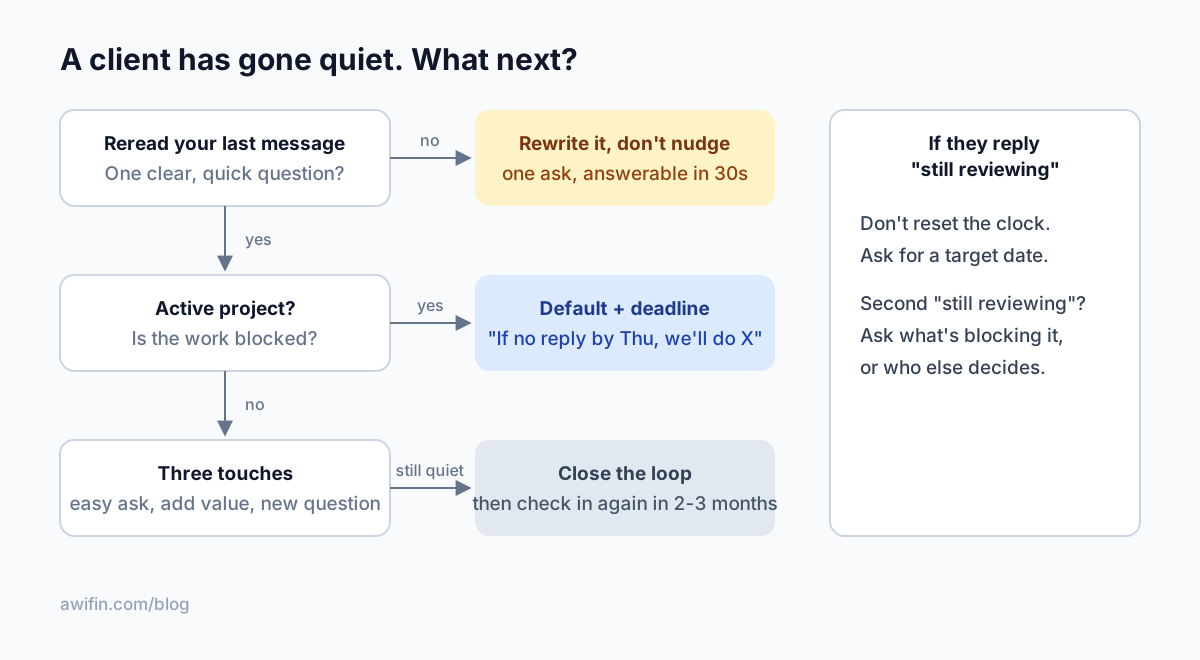
There's no magic number, but these are sensible defaults:- After a proposal: 3 to 5 business days. If they gave you a decision date, follow up the day after it.
- After a question you need answered: 2 to 3 business days.
- When you're waiting on something with a deadline: the day before you actually need it, not the day after.
- Quiet active client: a week or two, depending on how often you normally talk.
Before you nudge, reread your last message
Silence is often caused by the message you sent, not by the client. Open the last email that got no reply and check it against this list:- Was there a question? "Here's the update, let me know your thoughts" isn't a question. There's nothing to answer.
- How many asks were in it? Three questions in one email usually get zero answers. The client means to reply "properly" later, and later never comes.
- Could they answer in under 30 seconds? "What do you think of the overall direction?" takes thinking. "Option A or option B?" doesn't.
- Was the ask at the bottom of a long message? Busy people read the first two lines on their phone.
- Was it buried in a long thread with a subject line from three weeks ago?
Before: "Hi Sarah, attached is the updated sitemap and the copy doc. We've also been thinking about the blog structure and whether the case studies should be their own section. Let us know your thoughts on everything when you get a chance."
After: "Hi Sarah, one quick decision needed: should case studies be their own menu item, or live under Work? A one-word answer is perfect. Sitemap and copy doc are attached for whenever you have time."The second one gets answered from a phone in a queue for coffee.There's data behind this. Boomerang, an email plugin, looked at reply rates across more than 40 million emails its users wanted follow-up reminders for. Emails of roughly 50 to 125 words got the best reply rates, and emails asking one to three questions were about 50% more likely to get a reply than emails with no question at all (Boomerang, 2016). It's correlation from one tool's users, not a controlled experiment, but it matches what most people see in their own inbox: short, with a real question, wins.
Message 1: make replying easy
Keep it short. Remind them what you're waiting for and ask one thing they can answer in a line.Hi Sarah, quick one on the homepage proposal. Is the scope roughly right, or would it help if I trimmed it to just the first phase?A yes/no or either/or question gets far more replies than "any thoughts?"
Message 2: add something useful
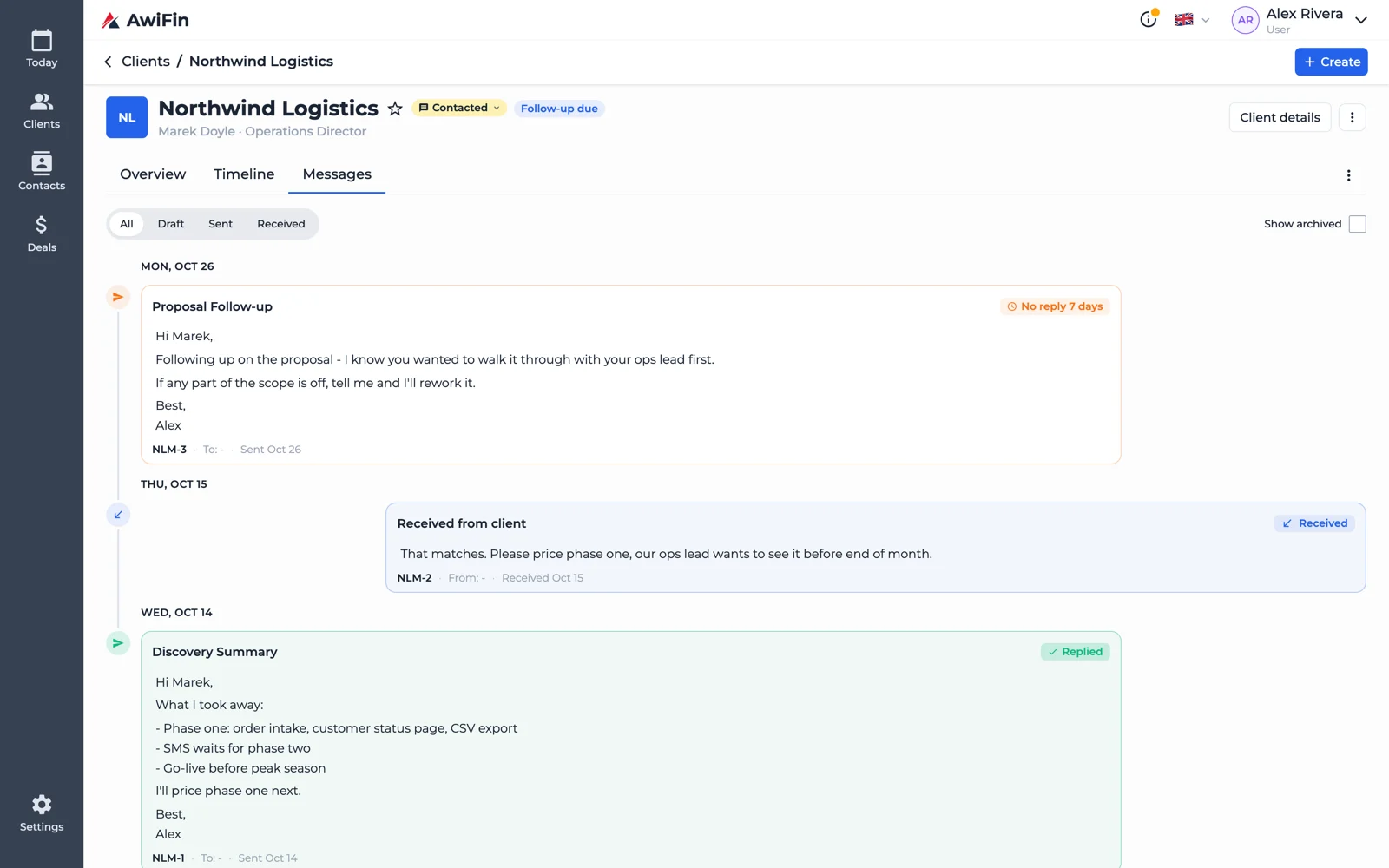
If the first nudge goes nowhere, don't send the same message again. Give them a new reason to reply: a short example, a timeline note, or an answer to an objection they might have.Hi Sarah, one thing I should have mentioned: if you want the new site live before your spring campaign, we'd need to start by the 15th. Happy to hold that slot until Friday.
Message 3: change the question
Still nothing? Ask about the situation, not the deal.Hi Sarah, I don't want to keep nudging if things have changed on your side. Has the project moved down the list, or is someone else now involved in the decision?This gives them permission to say "not now," which is a perfectly good answer. It's much better than silence.
The close-the-loop message
After three attempts spread over two or three weeks, send one last note and stop chasing.Hi Sarah, I'll assume the timing isn't right and stop filling your inbox. If it comes back up, just reply here and we'll pick it up from where we left off.Then, and this is the bit people skip, set a check-in date for later. Two or three months is common. Some of your best clients will reply to that later message.
Silence in the middle of a project: propose a default
With an active client, silence has a cost: the project stalls. Here the polite-nudge sequence is too slow. Use a default-and-deadline message instead. You state what you'll do if you don't hear back, and when:Hi Sarah, we need a decision on the case studies menu to finish the build this week. If I don't hear back by Thursday noon, we'll go with case studies under Work, which is easy to change later. Shout if you'd prefer otherwise.This works because it removes the need to reply. Silence becomes a decision. Defaults are one of the most powerful forces in decision-making: in a well-known comparison of European countries, consent to organ donation was dramatically higher where it was the default than where people had to opt in (Johnson and Goldstein, Science, 2003). A client choosing between your sensible default and writing a reply will usually take the default. Only use it for choices that are genuinely reversible and low-risk. Never use it for anything involving money, legal text, or content the client must sign off on.
When the reply is "still reviewing"
A reply that doesn't move anything forward ("still looking at it," "will get back to you soon") resets most people's follow-up clock. It shouldn't. Answer it with a request for a date:Thanks Sarah, no rush. Is there a day that works as a target, so I can plan our side? Even a rough one helps.If they give a date, follow up the day after it. If the second "still reviewing" arrives, something is blocking them that they haven't said. Ask directly: "Is there anything about the proposal that's making it hard to decide, or anyone else who needs to weigh in?"
Things that make silence worse
- Guilt-trip openers. "I haven't heard back..." puts the client on the defensive.
- Long messages. A quiet client won't read four paragraphs. Two or three lines is plenty.
- Switching channels too fast. Email, then LinkedIn, then a call on the same day feels like pressure.
- No date on the next attempt. Without one, follow-up two quietly never happens.
Keep the sequence somewhere other than your head
The hard part isn't the wording. It's remembering that Sarah was due a nudge on Thursday while three other clients need you too. Write down, for each quiet client: what you're waiting for, how many times you've followed up, and the date of the next attempt. A spreadsheet works. So does a simple follow-up system.Common questions
How many times should I follow up before giving up?
Three is a reasonable default, spread over two or three weeks, followed by a close-the-loop message. Then check back once in a few months.Should I call instead of emailing?
If you've talked by phone before, a short call after the second email is fine. If the relationship has been email-only, stay there.Is it rude to follow up?
No. Most clients appreciate a reminder, especially when the message is short and gives them an easy way to answer.Quiet clients in AwiFin
In AwiFin every client has a next action with a date, so a quiet client shows up in your daily list when the next nudge is due, not when you happen to remember. Waiting items stay visible with their check date. When it's time to write, AwiFin can draft the follow-up from the client's notes and earlier messages, and you edit it before sending.Sources
- Boomerang, 7 Tips for Getting More Responses to Your Emails (With Data!), 2016.
- E. J. Johnson and D. Goldstein, Do Defaults Save Lives?, Science, 2003.