What counts as a next action?
A next action is the next concrete step that moves things forward. "Acme website," "Proposal" and "Waiting" are not next actions. They're labels. These are:- Follow up with Sarah about the proposal on Thursday.
- Send James the progress update promised today.
- Ask Maya to approve homepage version 3.
Why just one?
A client might have dozens of open tasks. But from the relationship side, one thing usually matters most right now.Say development is blocked until the client signs off on the design. You may have twenty tickets in the backlog, but the real next action is "get the design approved." Everything else waits on that. Picking one makes the whole day easier to plan.How to pick the one
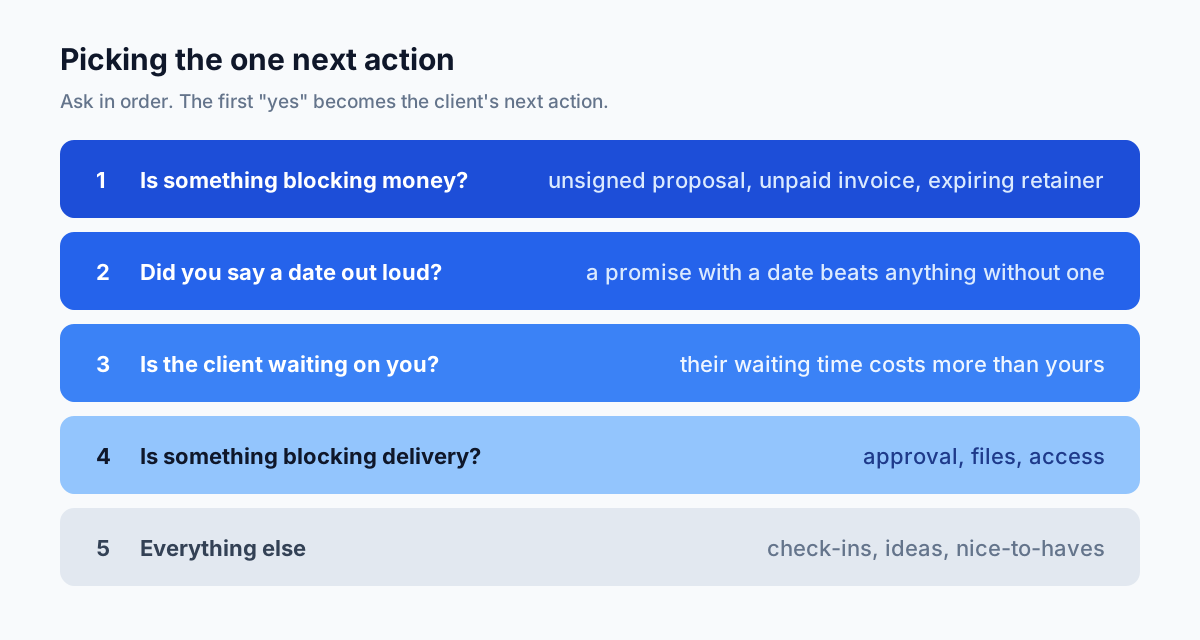
When a client has several open threads, rank them with these questions, in order:- Is something blocking money? An unsigned proposal, an unpaid invoice, an expiring retainer.
- Did you say a date out loud? A promise with a date beats anything without one.
- Is the client waiting on you? Their waiting time is more expensive than yours.
- Is something blocking delivery? An approval or missing assets that stall the team.
- Everything else: nice-to-haves, check-ins, ideas.
Dates that don't lie
A next action is only as good as its date. Three rules keep dates honest:- Date it when you'd actually do it, not when you'd like to. A list full of aspirational "today"s is a list you'll stop believing.
- Cap each day. If you can realistically handle six client actions a day, don't schedule fourteen. Push the lowest-ranked ones to quieter days when you set them, not when they go overdue.
- Waiting dates are check dates, not deadlines. "Check Thursday for assets" doesn't mean the client is late on Thursday. It means Thursday is when you look.
Four groups
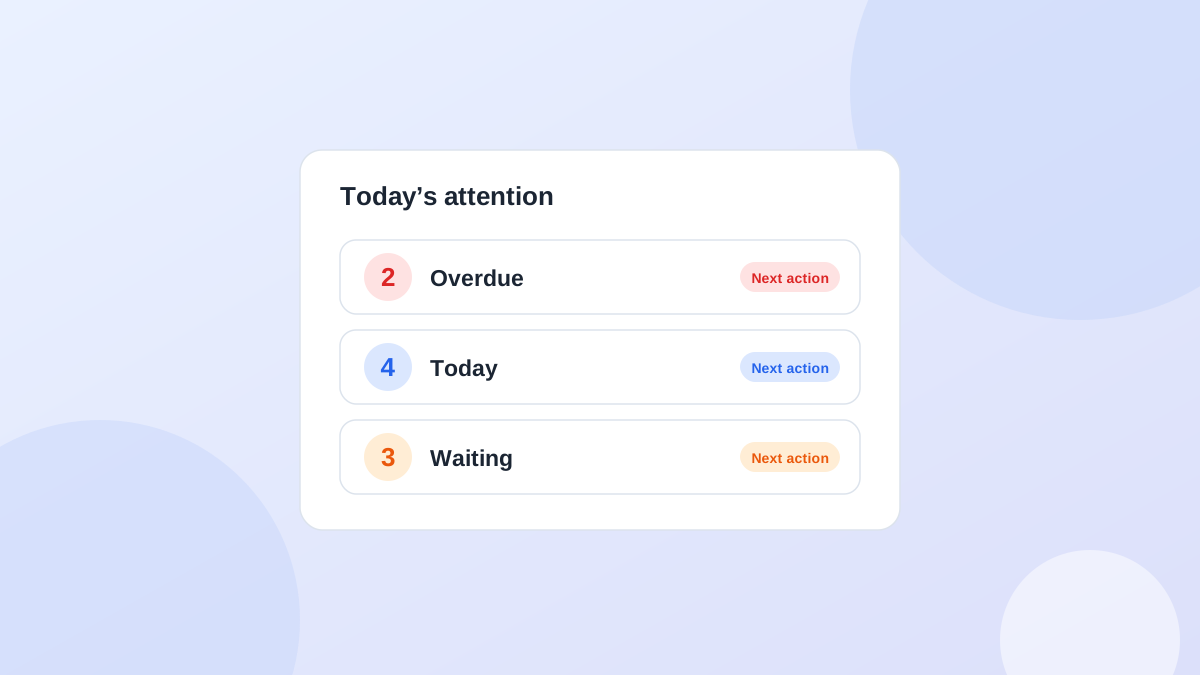
1. Overdue. Something should have happened already. An update you promised yesterday, a proposal follow-up from Monday, an unanswered question. Start here.2. Today. Scheduled for now: the weekly update, a proposal follow-up, an approval request, booking a call.3. Waiting. The client has the ball: feedback, files, approval, a yes or no. Every waiting item still needs a date when you'll check again. If the check date passes in silence, see how to follow up with a client who hasn't replied.4. Upcoming. Not urgent yet. Seeing it early means it doesn't become tomorrow's fire.Pipeline stage isn't enough
Stages like Lead, Qualified, Proposal and Won are useful, but they don't tell you what to do at 9am. Two prospects can both sit in "Proposal sent." One got it yesterday. The other got it nine days ago and hasn't replied. Same stage, very different morning.A next-action list shows that difference. A pipeline doesn't.Keep the reason
Two reminders:Follow up with Northwind.
Follow up with Northwind: no reply six days after the proposal.The second one tells you why, which also tells you what to write:
Hi Maya, just checking back on the proposal from last week. Happy to walk through the scope together if that's easier. Anything I can clarify before you decide?
Vague vs doable
VagueDoable
AcmeAsk Acme to approve homepage v3 by Thursday
ProposalFollow up on Northwind proposal if no reply by Wednesday
Waiting on clientCheck for Brightline assets on Monday, nudge if missing
UpdateSend James the progress update promised on today's call
Check inAsk Priya how the launch went, two weeks after go-live
What a morning looks like
With a list like this, a typical ten minutes goes:- Overdue (1): you promised Acme a revised scope yesterday. Send it now.
- Today (3): follow up on the Northwind proposal, ask Brightline for approval, book a call with a new lead.
- Waiting (4): Vertex assets are two days late, send a quick nudge. The other three can wait.
Close every conversation with "what's next?"
The easiest way to keep this running is to make it part of finishing anything:- After a meeting: what happens next?
- After sending a proposal: when do I follow up if there's no reply?
- After asking for approval: when do I check again?
- After a client request: when will I answer?
When nothing is needed
That's fine. Not every client needs something every day. Just make sure "nothing needed" is a choice you made, not something you forgot."No next action because everything's good" and "no next action because we forgot" look identical in most tools. They shouldn't.Common mistakes
- Several next actions per client. Pick the one that unblocks the most.
- Nouns instead of verbs. "Contract" is a topic. "Send contract to Alex" is an action.
- Waiting items with no date. They turn into forgotten items, quietly.
- Only updating when something breaks. Update after every conversation, while it's fresh.
You're managing attention, not inbox
Email sorts messages. A CRM sorts relationships. A project tool sorts work. Next actions sort attention, and if you're a founder doing sales and delivery at once, attention is the thing you're shortest on. You don't need to know everything about every client every morning. You need to know what needs you now.Common questions
How many clients can one person handle this way?
There's no magic number. It scales well because you only look at what's due, not at every client.Should each team member have their own next actions?
Yes, if different people own different clients. Every next action needs exactly one owner.What about retainer clients?
Give them a recurring next action, like a monthly check-in or status update. Otherwise the quiet, happy clients are the ones that drift.Next actions in AwiFin
Sources
- David Allen, Getting Things Done: The Art of Stress-Free Productivity, 2001 (revised 2015). Origin of the "next action" concept.
- P. M. Gollwitzer and P. Sheeran, Implementation intentions and goal achievement: A meta-analysis of effects and processes, Advances in Experimental Social Psychology, 2006.