"I'll send that over tomorrow."
"We'll revise the proposal."
"Let me check with the developer and come back to you."
"Send me the document and I'll approve it."None of these feels big enough to become a ticket. But forgetting one can damage trust faster than a missed deadline on a large task, because the client noticed and you didn't. Promises need a different system from normal project work.
Why promises get forgotten
Project work has structure: a feature has a ticket, a design has a deadline. A promise usually starts as one sentence on a call. The meeting ends, everyone returns to their work, and the commitment ends up in meeting notes, an email thread or someone's memory.The problem isn't productivity. The commitment never became a next action.Catch the promise when it's spoken
Train yourself to notice the phrases that signal a commitment, from either side:- "I'll send..." / "We'll get back to you..."
- "Let me check and..." / "I'll look into..."
- "Once you send..., we can..."
- "Can you share... by Friday?"
- "We'll decide by..."
- "I'll introduce you to..."
Convert it into a next action straight away
The note "send revised estimate" is not enough. Turn it into:- Next action: Send revised estimate to Northwind
- Due: Friday
- Reason: Promised during Wednesday's call
Track both sides
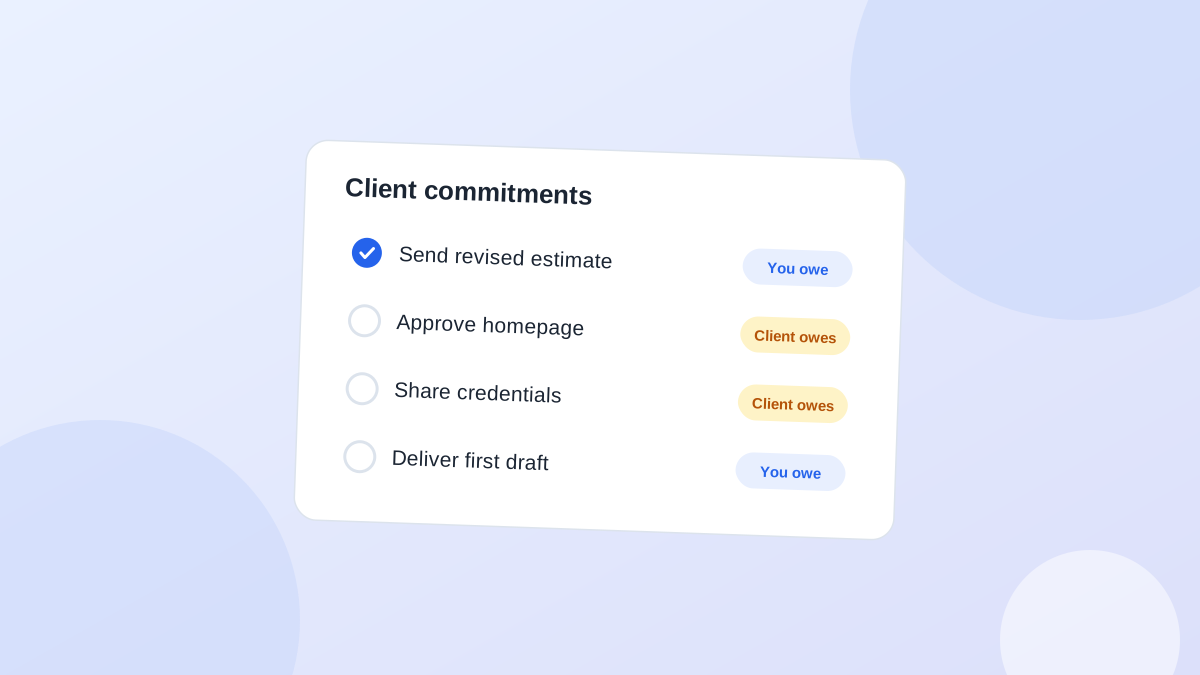
Client relationships contain two kinds of commitments.You owe the clientThe client owes you
Proposal or estimateApproval of design or scope
Progress updateCredentials and access
Answer to a questionFeedback on a draft
Document or fileAssets and content
Meeting scheduledPayment of an invoice
"Waiting" should never mean forgotten
You request approval on Monday. The client says they'll take a look. You mark your task complete because your part is done.This is exactly how approvals vanish. Instead, record:- Waiting for: homepage approval
- Since: Monday
- Next check: Thursday
Don't turn every promise into a project task
A common response is to put everything into ClickUp, Asana or Jira. That can work, but it fills your delivery board with relationship admin: "follow up with Sarah," "ask John for approval," "check whether Mike replied." Those are communication actions around the work, not deliverables.For many small agencies it helps to keep them apart. Your project tool answers "what work needs to be completed?" Your relationship system answers "what does this client need from us next?"Use the history when you follow up
A reminder that says "contact Sarah" is better than nothing, but you still have to work out what to say. A reminder that keeps the reason is far more useful:Waiting six days for approval of homepage version 3.Now the message nearly writes itself:
Hi Sarah, just checking whether you've had a chance to review the latest homepage version. If it looks good, we can move into implementation. Happy to clarify anything before you approve.
When you're the one who's late
You will miss a promise at some point. How you handle it matters more than the miss. Say so early, give a new date, and keep it short:Hi Alex, I owe you the revised estimate and it's going to land Monday rather than today. I wanted to tell you now so you aren't left waiting. I'll send it by noon Monday.An early, specific message almost always lands better than silence followed by an apology.
A five-minute daily review
You don't need a heavy weekly process. Each morning, scan for:- Promises you made that are overdue or due today
- Client requests waiting for your reply
- Approvals and inputs you are still waiting on, and for how long
- Anything you've been waiting on long enough that it needs a nudge
A quick test
Look at your current clients. Can you immediately answer:- What did you most recently promise each one?
- What are you waiting for from them?
- When will you contact them next?
- Which relationship is overdue right now?